Press kit
Everything on this page may be used freely in articles and videos. Right-click any image to save it.
Factsheet
Realms in Embers is a turn-based fantasy strategy game for the browser: a compact 4X war chronicle in the spirit of SSI's 1993 classic Fantasy Empires, with original fiction and original rules. You pick one of twelve painted lords, expand across a procedurally forged realm, and reach one of five endings while a dead chronicler named Osperan narrates the whole affair. A full campaign fills an evening; a short chronicle fits a lunch break.
- Developer
- Michel Strasser (personal project, one person)
- Release state
- v0.5.0, live and playable
- Platform
- Web browser, desktop and phone; installs as a PWA and works offline after the first load
- Price
- Free. No account, no ads, no tracking, nothing to install.
- Play
- realmsinembers.com
- Source
- github.com/michael-chipmates/realms-in-embers (code AGPL-3.0, story and art CC BY-SA 4.0)
- Contact
- strasserm@chipmates.ai
Features
- Twelve lords in three creeds, each with a legacy that shapes their rule and a signature order that is theirs alone. The AI genuinely plays every temperament.
- Every number explains itself: hover income, order, attitude, or victory standing and the game itemizes where it comes from.
- Honest battles: before any blood, a Monte-Carlo preview shows both sides' full modifiers in plain words, run on a forked RNG so checking your odds can never change your fate.
- Five endings: conquest, dominion, a golden age, the Legend of the rekindled throne, or the judgment of the Chronicle when the page runs out. Every game ends; from season 38 late wars are pushed toward thrones, not timeouts.
- Three ways to war: online with end-to-end-encrypted invite links for up to six players, hotseat on one device, or courier (war by letters, the save file carried between turns).
- A procedurally forged realm: every seed is shareable and reforges identically.
- The Codex, an in-game handbook whose every number is rendered from the engine's own constants, so the book cannot drift from the battlefield.
- A saga export that hands you the whole war as a written story when it is over.
- Under 190 KB of gzipped JavaScript (about 170 KB today, budget-enforced in CI) with zero runtime dependencies.
Media
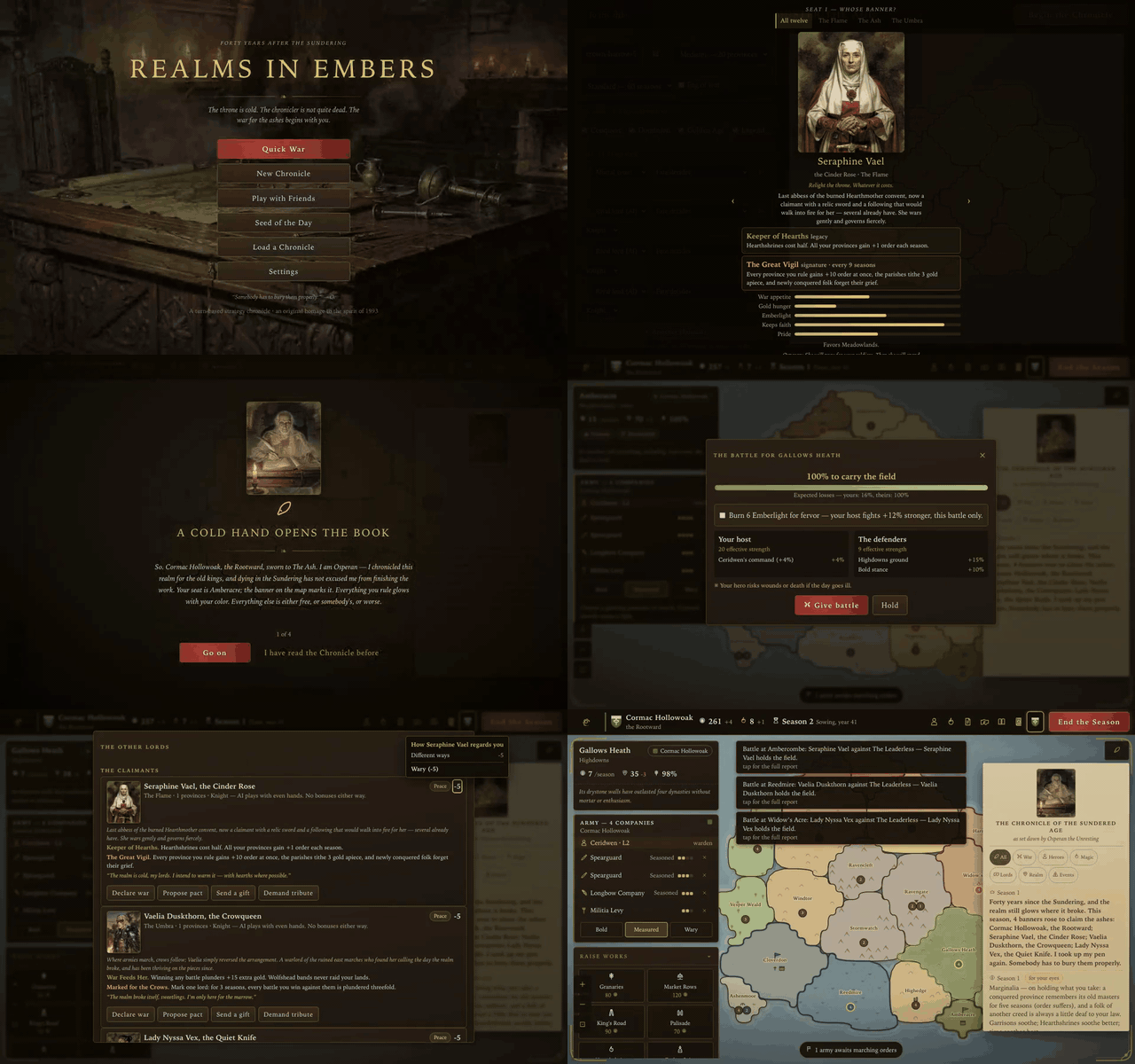
Six screenshots (1280×800 PNG), a 23-second video tour, and the same tour as a GIF.
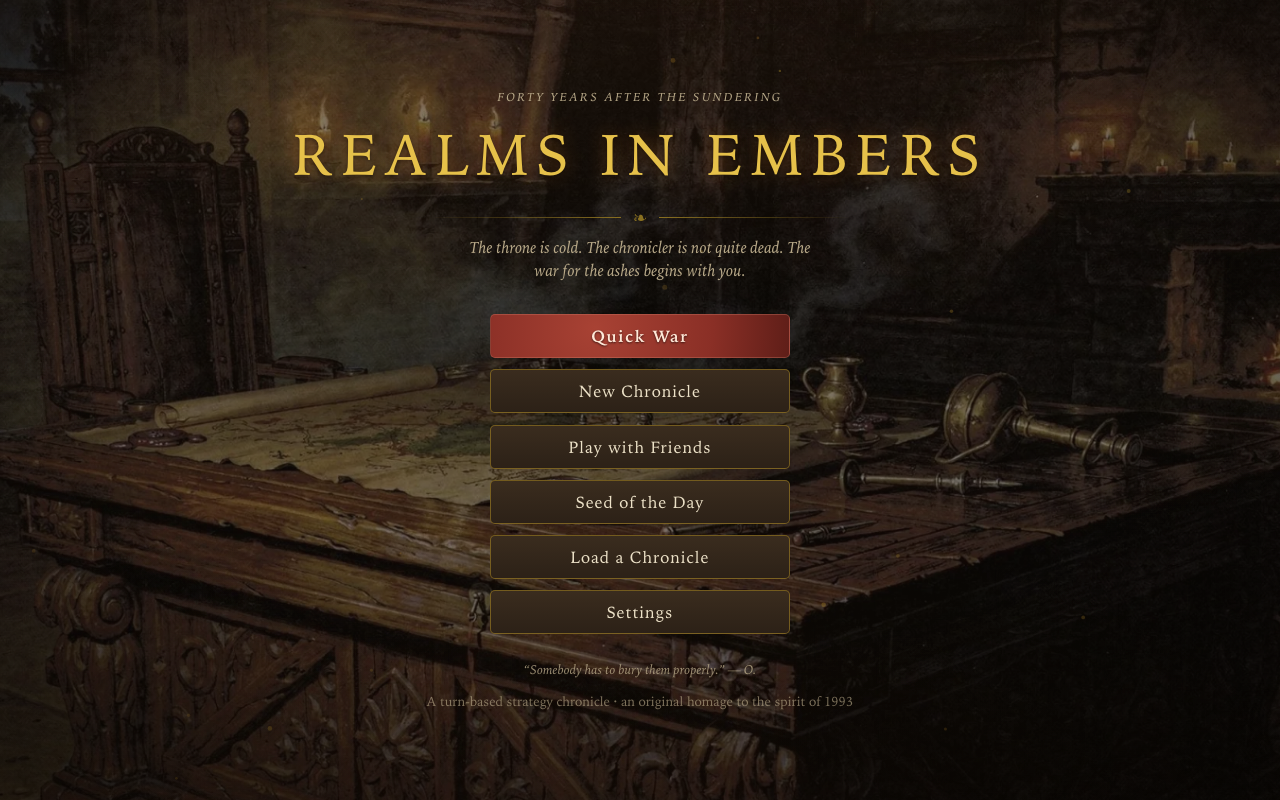
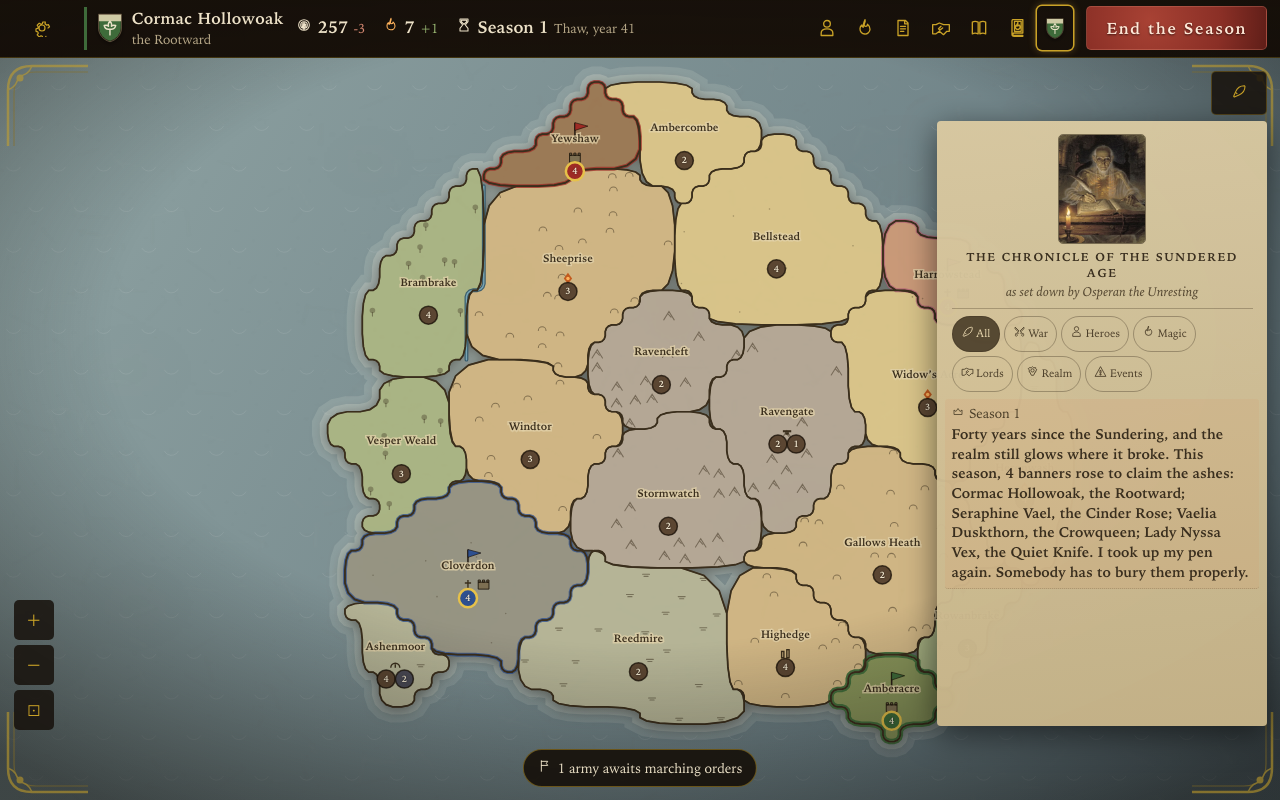
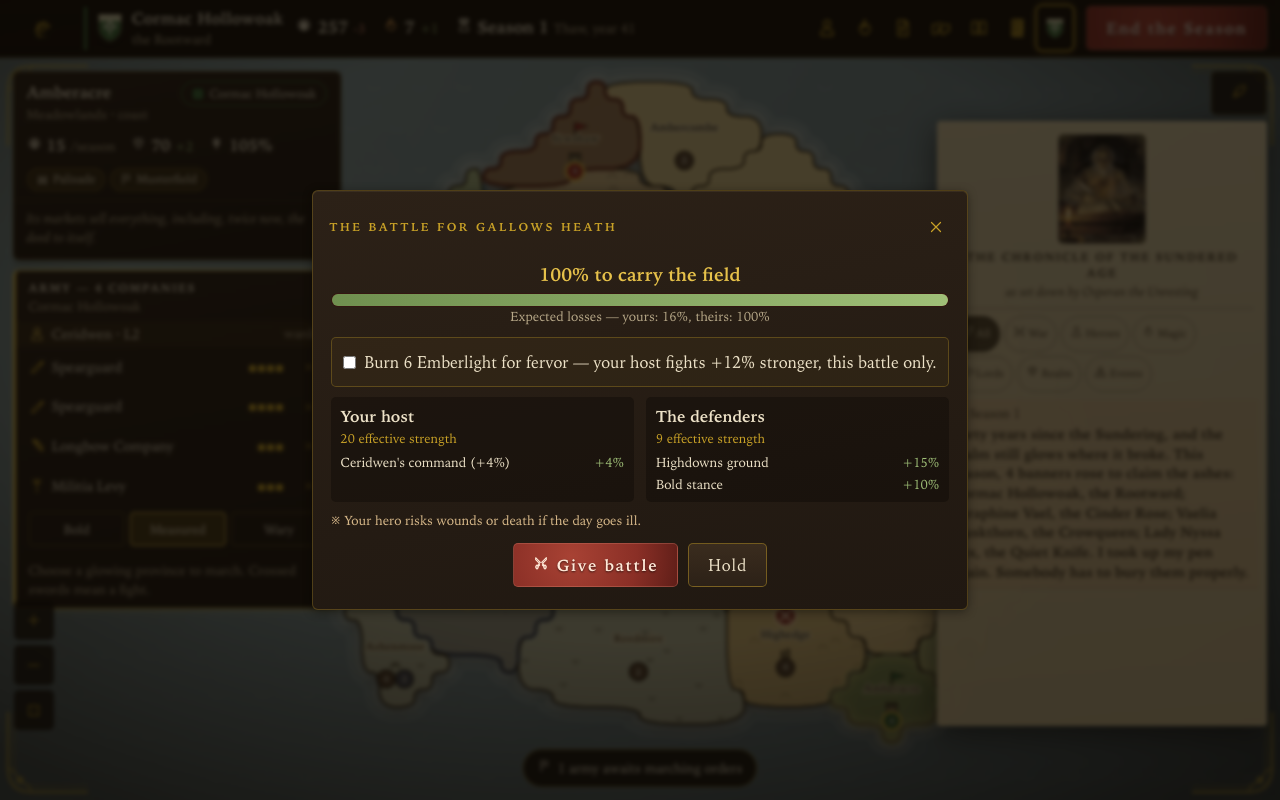
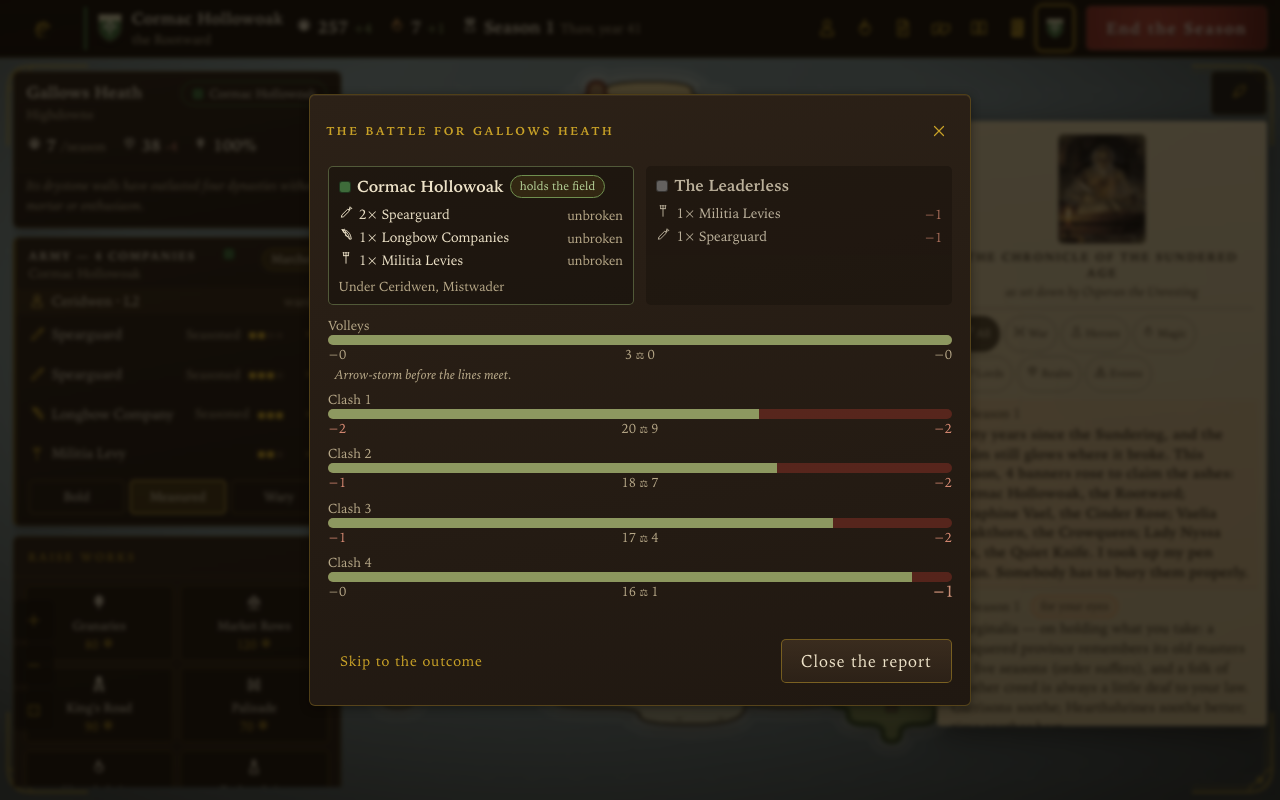
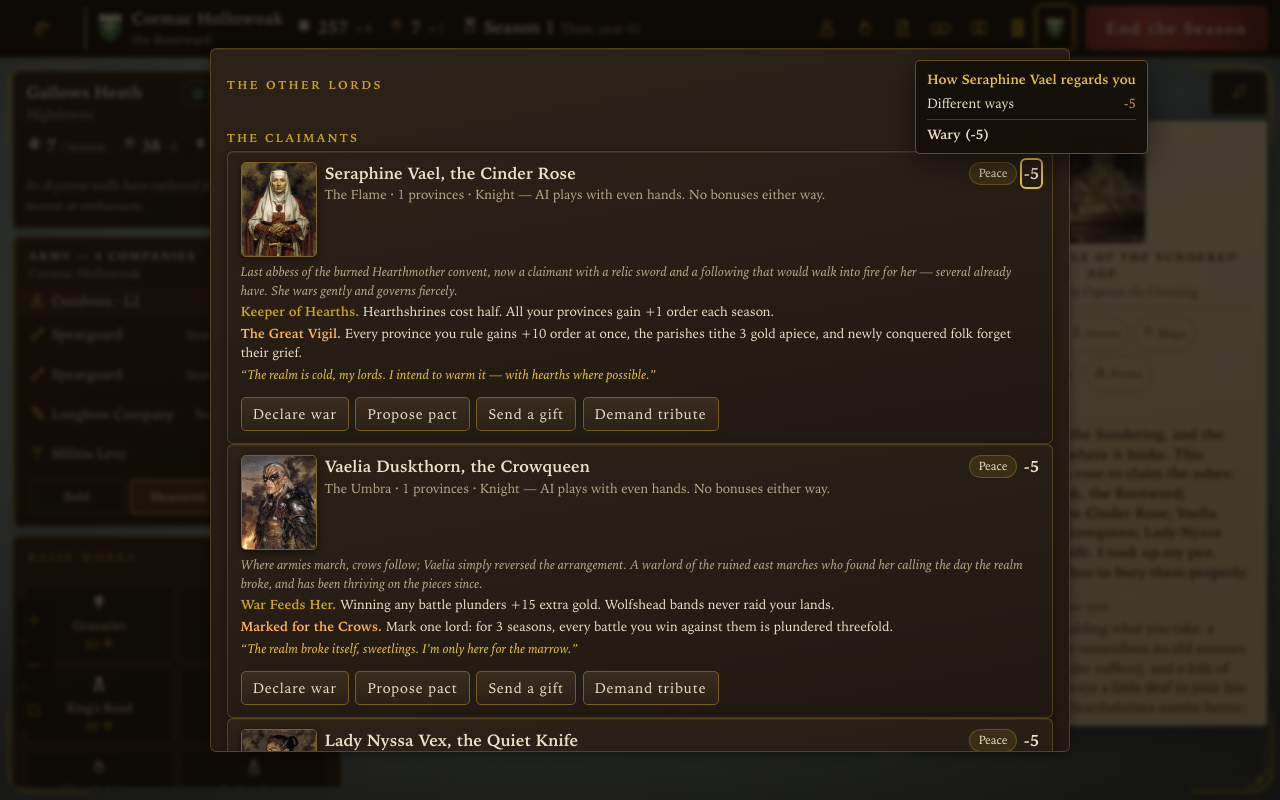
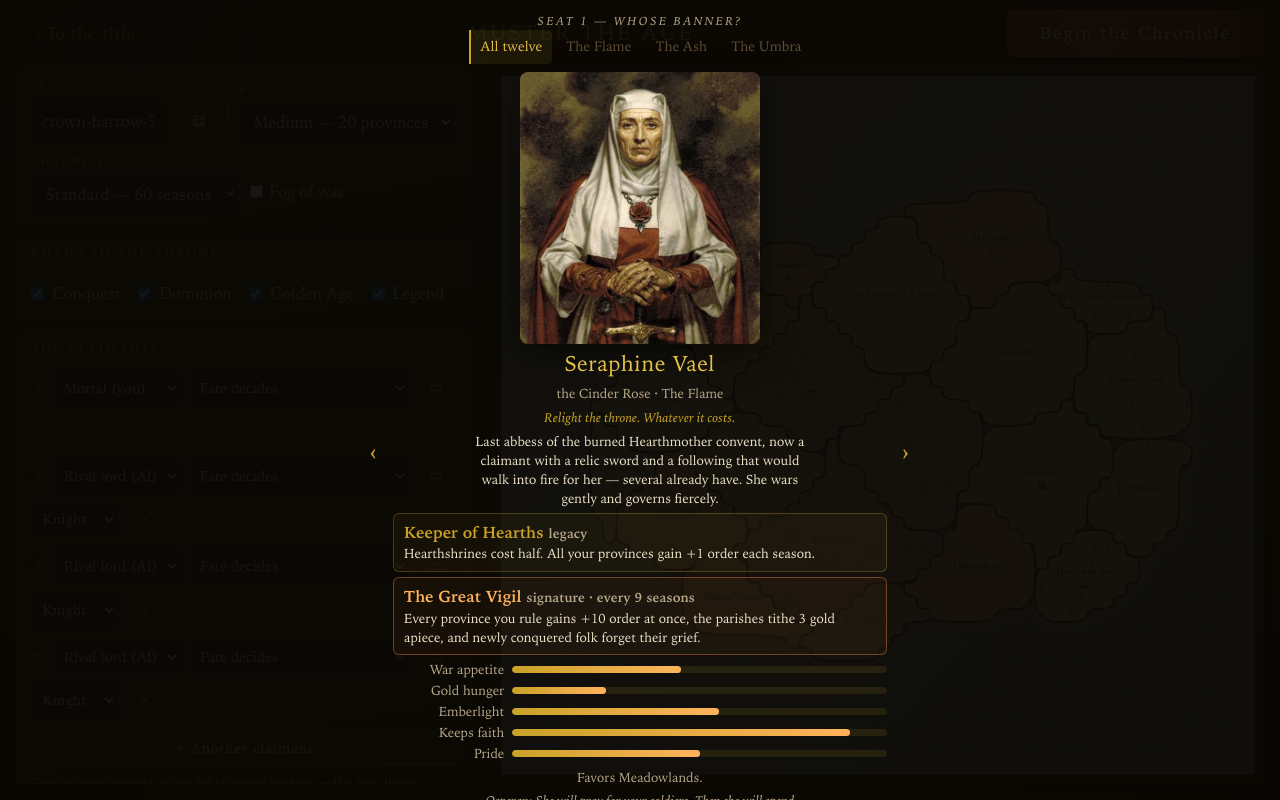
One tour of Realms in Embers: the hall, the war table, an honest battle, the painted lords. Direct files: MP4 (0.9 MB) · GIF (2.8 MB).
About the art
The painted illustrations (portraits, chapter plates, the title hall) are AI-generated (Black Forest Labs' FLUX.2 via the Replicate API), art-directed and curated for this game in a late-1980s game-manual airbrush style. Generated media of this kind may not carry copyright protection in some jurisdictions; to whatever extent rights exist in the curated set, they are licensed under CC BY-SA 4.0. All other visual material (the map rendering, heraldry, iconography, and UI) is procedural or hand-authored code. The full disclosure lives in CREDITS.md.
Music
Penumbra and Song Of The Forge by Scott Buckley, released under CC BY 4.0 and credited in-game. The tracks are re-encoded for lighter delivery and otherwise unmodified.
What to write about
- One log to rule them all. The engine is deterministic: every move, human or AI, is an action in a log, and seed plus log replays byte-identically. That one design decision is simultaneously the save format, the replay system, the multiplayer netcode, and the bug report.
- A language model sat down to playtest. A script seats an LLM at the table through the real engine. On its first outing it found a genuine exploit (the counting-house was lending gold it could never collect before the game ended) and filed a structured complaint about the error messages. Both fixed.
- Under 190 KB. The whole game (engine, AI, UI) is about 170 KB of gzipped JavaScript with zero runtime dependencies, and CI fails any build past 190. It loads fast on a phone and keeps working offline.
- The relay is blind. Online games are end-to-end encrypted with a key that lives only in the invite link's URL fragment, which browsers never send to any server. The relay stores ciphertext and ordinals; it cannot read a single move.
- Every number explains itself. Hover anything (income, order, a rival's grudge) and the game itemizes the causes. The in-game handbook is rendered from the engine's own constants, so the rules you read are the rules that run.